
Building for Healthcare: Why Generic Field Service Tools Fall Short
ServiceTitan, FieldEdge, and Samsara are great for HVAC and plumbing. But DME and respiratory care have requirements that horizontal platforms were never designed to handle.
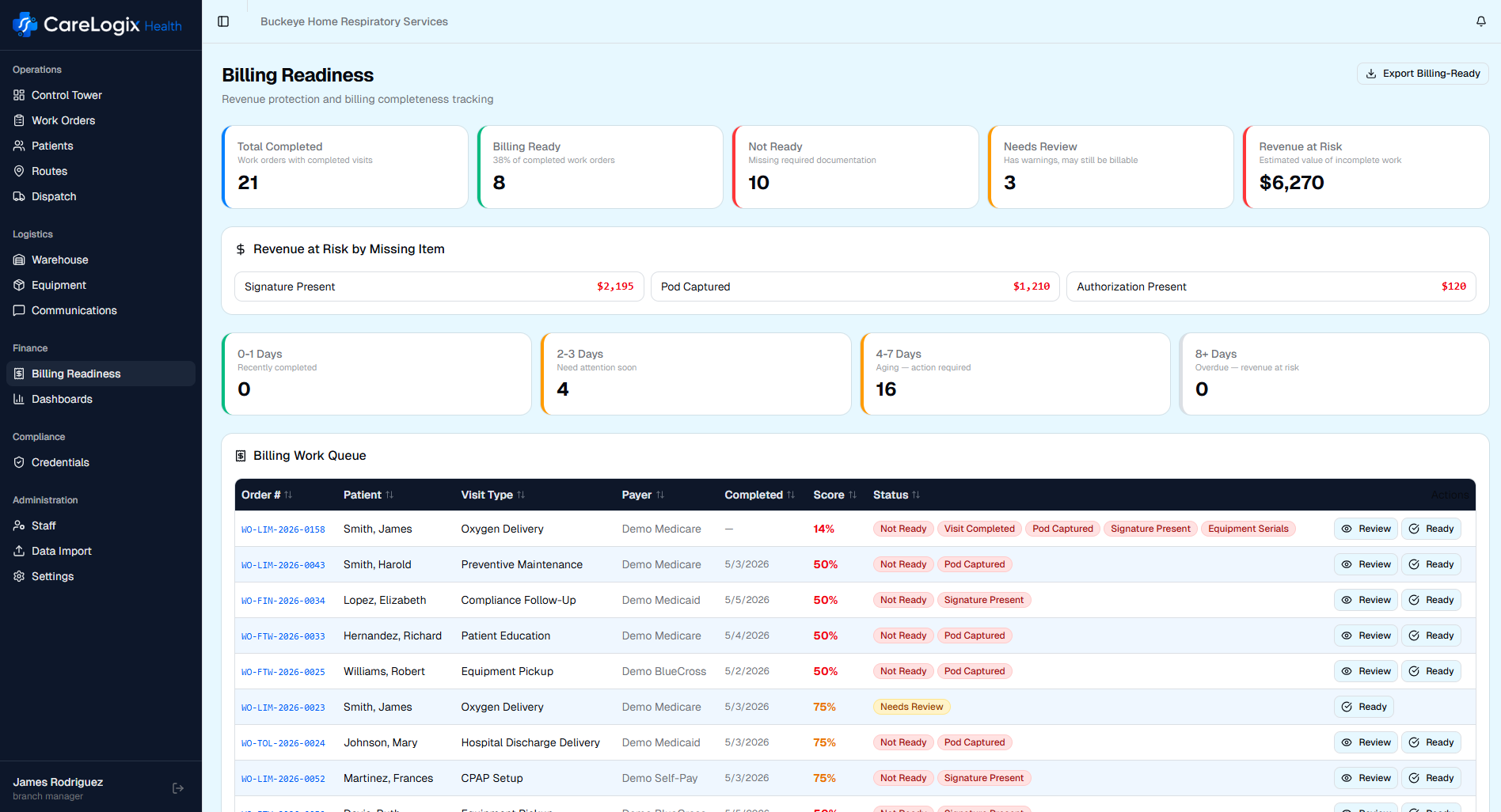
When DME providers go looking for field service management software, they often start with the big names: ServiceTitan, FieldEdge, Samsara, Housecall Pro. These platforms dominate in HVAC, plumbing, electrical, and general field service. They're well-built, well-funded, and mature. And they're fundamentally wrong for healthcare field operations.
This isn't a criticism of those platforms. They solve their target market's problems brilliantly. But DME and respiratory care operate under a completely different set of constraints, and trying to force a horizontal FSM tool into a healthcare workflow creates friction at every turn.
HCPCS Codes, Not Part Numbers
In HVAC, a technician installs a part and bills the customer for parts and labor. In DME, a delivery is billed to Medicare, Medicaid, or a commercial payer using HCPCS codes that determine reimbursement rates, documentation requirements, and coverage rules. A single oxygen concentrator delivery might involve codes E1390, E0431, and E0443, each with different billing rules.
Generic field service tools have no concept of HCPCS codes. They track parts and inventory, not billable medical equipment categories. This means DME providers using these tools end up maintaining a parallel billing system, manually mapping completed work orders to the correct codes for claim submission. That manual mapping introduces errors, delays billing, and creates a disconnect between field operations and revenue cycle.
Prior Authorization Is Not Optional
Before a DME provider can deliver many types of equipment, they need prior authorization from the payer. This process involves submitting clinical documentation, receiving approval (or denial), and tracking authorization validity periods. A technician should never be dispatched for a delivery that hasn't been authorized, because the provider won't get paid.
ServiceTitan doesn't know what a prior authorization is. Neither does FieldEdge. These platforms manage work orders and scheduling, but they have no mechanism to gate dispatch on payer authorization status. In practice, DME providers using these tools rely on manual checks and tribal knowledge to prevent unauthorized deliveries. This works until it doesn't, and when it fails, the provider absorbs the cost.
Credential Matching Is a Hard Requirement
In general field service, any available technician can usually be dispatched to any job. In DME, technicians must be credentialed with specific payers to serve their patients. A respiratory therapist credentialed with Blue Cross but not Aetna cannot be sent to an Aetna patient, even if they're the closest available tech with the right equipment on their truck.
Horizontal FSM platforms have skill-based routing, which sounds similar but isn't. Skill tags are advisory. Credential requirements are absolute. Dispatching a non-credentialed technician to a patient isn't a suboptimal choice; it's a compliance violation that results in denied claims. The routing engine needs to treat credentials as hard constraints, not preferences.
Documentation Follows the Equipment
When an HVAC technician completes a job, they might take a photo and get a signature. When a DME technician delivers a CPAP machine, they need the patient to sign a delivery ticket, acknowledge receipt of equipment, confirm patient education was provided, and capture specific clinical data that may be required for ongoing reimbursement. Different equipment types have different documentation requirements, and those requirements vary by payer.
Generic FSM tools offer customizable forms, which in theory could be configured for healthcare documentation. In practice, maintaining dozens of payer-specific, equipment-specific documentation templates inside a tool that wasn't designed for this purpose becomes an administrative nightmare. The forms break, fields get missed, and claims get denied.
Why CareLogix Exists
We built CareLogix because we watched DME providers try to make generic tools work and saw the same pattern repeat. Initial enthusiasm, months of customization, growing frustration, and eventually a return to spreadsheets and manual processes for everything the FSM tool couldn't handle.
Healthcare field operations deserve a platform built from the ground up for healthcare. One where HCPCS codes are native, prior authorization status gates dispatch, credential matching is a hard constraint in routing, and documentation requirements are built into the workflow by equipment type and payer. Not bolted on. Not configured through custom fields. Built in.
You wouldn't run a hospital on software designed for a hotel. Don't run healthcare field operations on software designed for plumbing.
About the Author

Adam Donaldson
Founder, CareLogix Health
Adam built CareLogix after years of implementing field operations systems at enterprise DME providers. He saw firsthand how fragmented tools, manual processes, and disconnected workflows cost branches hours every day and leak revenue that should have been captured. CareLogix is the platform he wished existed when he was on the implementation side.
Connect on LinkedInSee CareLogix in Action
Schedule a 30-minute walkthrough and see how CareLogix manages the full work order lifecycle for DME providers like you.